Managing corporate cards and maintaining fiscal oversight across multiple markets and subsidiaries can be a complex task for CFOs and group finance leaders. The challenge: They need centralised visibility and control while preserving local autonomy. Discover how fragmented banking setups create operational risk and inefficiency, and how a unified financial infrastructure simplifies multi-entity management.
With amnis, international enterprises manage subsidiary finances across 20+ currencies, issue cards within seconds, and automate more than 90% of reconciliation and accounting workflows – all from one central platform.
Common challenges of managing finances across subsidiaries
Dealing with multiple currencies, FX margins and international payments across jurisdictions presents unique challenges that can slow operations and increase risk. Organisations often deal with fragmented bank accounts and card providers, which create silos and complicate cash management.
Common challenges include:
Financial silos through fragmented bank accounts and card providers
Limited real-time visibility at group level
Increased compliance risks due to inconsistent spend policies and approval workflows
Exchange rate exposure, impacting margins and cash flow
Reconciliation problems, slowing month-end close and reporting
amnis addresses these challenges by centralising all financial data on a single payment platform – all while granting local CFOs the autonomy to manage their own payments, currency exchanges, cards and workflows.
What is the impact of a fragmented financial infrastructure?
A fragmented financial infrastructure is the core of most challenges when it comes to managing finances across subsidiaries, as separate accounts lead to multiple card providers, currencies, expense tracking and reporting.
Decentralised financial structures also introduce risk in terms of unmonitored spending, inconsistent approval policies, and delayed cash flow visibility. Multiple currencies add further complexity, as fluctuating exchange rates can directly affect margins.
Moreover, scattered systems slow down strategic decision-making. Executives lack a consolidated, real-time view of all group finances, which limits their ability to allocate resources effectively and respond quickly to market changes.
amnis helps organisations turn this challenge into an advantage by providing access to a financial ecosystem, which offers real-time insights and holistic tools for unified reporting, while corporate cards can be issued instantly to departments, teams and even individuals all over the world.
Why centralised financial management is the foundation
Centralised financial management is the cornerstone of efficient and scalable multi-subsidiary operations and international money transfer. By consolidating all financial processes into a single platform, finance teams can enforce consistent policies, monitor cash flow across all subsidiaries, and quickly identify anomalies or compliance issues.
Centralisation also reduces reconciliation complexity and mitigates risks associated with fragmented systems, including overspending, delayed reporting, and exposure to exchange rate fluctuations. In contrast, decentralised financial management can result in fragmented reporting, inconsistent approval processes, slower decision-making, and higher operational costs.
amnis bridges this gap with a single, centralised login and dashboard that enables operational independence at subsidiary level while giving a consolidated oversight and control at group level.
The difference between centralised and decentralised financial management becomes evident when comparing key operational outcomes:
Centralised financial management
Decentralised financial management
Visibility
Real-time, consolidated dashboards across all subsidiaries
Limited, siloed reports per subsidiary
Policy enforcement
Standardised spend policies and approval workflows
Inconsistent policies, manual enforcement
Currency management
Multi-currency transactions and FX risk managed centrally
Manual or inconsistent handling across subsidiaries
Scalability
Supports growth with automated operations
Growth adds complexity, bottlenecks, and risk
Reconciliation
Automated, faster, and accurate
Manual, time-consuming, and error-prone
Strategic decision-making
Faster, data-driven decisions at group level
Slower, reactive decision-making
Managing corporate cards across subsidiaries
When it comes to corporate cards, cross-border organisations face a persistent challenge: balancing scalability, local flexibility, and central oversight. Achieving all three at once has long seemed impossible. amnis’ corporate banking solutions solve this puzzle with physical and virtual multi-currency debit cards.
Corporate card management made easy
Issuing cards at scale
Quickly deploy physical and virtual cards across multiple subsidiaries and teams
Centralised access, local control
Maintain group-level oversight while allowing subsidiaries to manage their own card usage
Establishing spend controls and approval workflows
Enforce company policies and approval hierarchies for consistent, compliant spending
Real-time financial visibility at group level
Track and consolidate transactions across subsidiaries instantly
Virtual cards for vendors, projects, and one-off purchases
Generate disposable or project-specific cards for flexible, controlled spending
Facilitated multi-currency management
Manage payments in multiple currencies from one single account
As organisations grow, issuing corporate cards across different markets becomes difficult to control. A scalable approach enables finance teams to issue cards quickly when onboarding employees, departments, or new subsidiaries, all while maintaining consistent rules and limits. This reduces administrative workload and ensures teams have timely access to funds without compromising governance. With amnis, your finance team can keep in control, set spending limits, restrictions and block cards immediately when needed.
Centralised access, local control
Balancing group-level oversight with local decision-making is critical in multi-subsidiary environments. Centralised access ensures leadership retains visibility, while local finance teams manage day-to-day spending within predefined limits. This model reduces approval bottlenecks and allows subsidiaries to operate efficiently without losing alignment with group policies. amnis enables this balance by combining central visibility with configurable permissions for payments and card management at a local level.
Establishing spend controls and approval workflows
Clear spending limits and approval structures prevent overspending and ensure compliance. Standardised workflows reduce risk, simplify audits, and create consistency across subsidiaries, even when operating in different regions or under different regulatory conditions. With amnis, spend controls and approval rules can be defined centrally and applied across all subsidiaries.
Real-time financial visibility at group level
Real-time visibility into card transactions allows finance teams to monitor cash flow, identify anomalies, and respond quickly to unexpected spending. This level of visibility supports better forecasting, and stronger financial control at group level. amnis provides real-time dashboards that consolidate card activities across all subsidiaries into a single view.
Virtual cards for vendors, projects, and one-off purchases
Virtual cards are commonly used for supplier payments and project-related expenses. Each card can be assigned to a specific purpose, which helps ensure payments are made only where intended. This makes it much easier to track costs and reduces the risk of maverick spending. Virtual cards can also easily be closed once a project or payment cycle is complete. Reconciliation is also simpler, as transactions are clearly linked to a vendor or activity. With amnis, organisations can instantly create virtual cards for vendors or projects across all subsidiaries.
Facilitated multi-currency management
In a subsidiary structure, each country usually operates its own bank accounts in local currencies. While this is necessary for daily operations, it makes it harder to track balances, payments, and exposure across the group. Currency conversions may be handled differently in each entity, which can reduce transparency and complicate reporting, while unnecessary FX margins are paid across different subsidiaries. Without a consolidated view, finance teams struggle to understand cash positions and currency risk at group level. amnis’ multi-currency account facilitates international transfers, while subsidiaries benefit from local payment schemes such as SEPA, ACH and more, no matter where they are located.
The future of financial automation across subsidiaries
The future of financial management is increasingly defined by automation, integration, and real-time data. As organisations expand internationally, manual processes and disconnected systems no longer scale. Finance teams are moving away from reactive reporting towards continuous oversight, where payments, balances, and spending activity are visible as they happen.
Routine tasks such as reconciliations, intercompany settlements, and foreign currency exchange are becoming automated, which lowers error rates and shorts month-end close cycles. Another key shift is the move towards group-level transparency without removing local responsibility. Modern financial infrastructures support local entities operating in their required currencies and payment rails, while providing headquarters with a consolidated view for decision-making and risk management.
amnis’ automation first approach already enables companies today to reach over 90% automation in reconciliation and accounting entries.
How amnis supports centralised subsidiary finance
With amnis, global companies access a unified financial ecosystem that bundles subsidiary finances in one single place. Key financial workflows are automated, and multi-currency debit cards can be issued to subsidiaries within seconds – for more flexibility and control as your business scales.
Central management requires a consolidated system that connects all subsidiaries’ accounts, payments, and reporting. Standardised policies, automated workflows, and real-time dashboards allow finance teams to monitor cash flow, enforce compliance, and make informed decisions at the group level. amnis provides a central hub that unifies subsidiary finances while still allowing local teams to operate independently.
amnis’ corporate cards can be issued per subsidiary, department, project, or employee, with spending limits and customised to local needs, while financial overviews are tracked centrally. Virtual and physical multi-currency cards simplify payments for vendors, projects, or one-off expenses.
Yes. Subsidiaries typically transact in their local currencies to simplify operations. Effective multi-currency management ensures that transactions, balances, and reporting remain clear for both local teams and group finance. With amnis, subsidiaries can spend in domestic and foreign currencies at local costs while finance retains central visibility and control over FX exposure.
Decentralised management can lead to fragmented reporting, inconsistent policies, slow approvals, and higher operational risk. Without central oversight, organisations may struggle with cash visibility, regulatory compliance, and currency exposure. Centralised platforms like amnis mitigate these risks by providing unified reporting and workflow control across all subsidiaries.
Elena Tankovski · Content Marketing Manager
As Senior Content Writer at amnis, Elena transforms complex financial and banking topics into clear, insightful content for SMEs. She focuses on areas such as the FX market, international payments, cross-border business operations, and regulatory updates - ensuring companies have access to reliable and easy-to-understand guidance.
With a strong background in research and communication, Elena plays a key role in helping businesses stay informed, make smarter decisions, and navigate the evolving world of international finance.
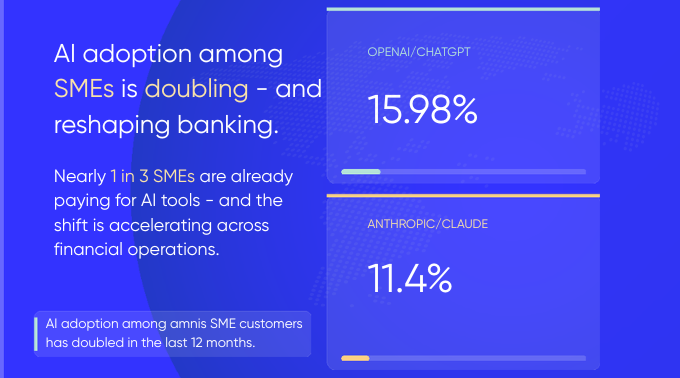
Nearly 1 in 3 amnis SME customers is paying for a leading AI platform. AI adoption among SMEs has doubled in 12 months — here's what the data shows and what we're building in response.