I am convinced that the finance portal as we know it, the one you log into, click through and export files from, is on its way out. Not this year, and not because anyone decides to switch it off. It will simply stop being the place where the work happens. That shift is already underway at our customers, and it is the reason we opened the amnis platform to AI assistants.
The signal came from our own payment data
Most predictions about AI adoption in small and mid-sized companies are built on surveys. Ours is built on payments.
Our latest card transaction data shows that 64% of business partners using amnis cards already pay for at least one AI tool. ChatGPT alone appears in the spending of 19% of them, Claude in 17%, while another 28% pay for other AI tools – from Perplexity and Mistral to Cursor, Lovable and dozens more.
This is no longer experimental spending. AI has become a recurring line item for a majority of these businesses. We wrote about what the earlier data was already showing in more detail earlier this year.
What matters is not the percentage itself. It is what it implies. If a finance team has an AI assistant open all day, that assistant becomes the place where questions get asked first. And if the answer to “what is our EUR position?” requires leaving that window, logging into a portal and exporting a file, then the portal has quietly become the slow part of the process.
Language models are becoming the operating layer companies work in. We have to be present where our customers actually work, not where we would prefer them to come.
Meet customers where they already are
The obvious response would have been to build our own chat window inside the amnis app and call it done. We are doing that too. But it only solves half the problem, because it still asks customers to come to us – rather than making amnis available where they already work.
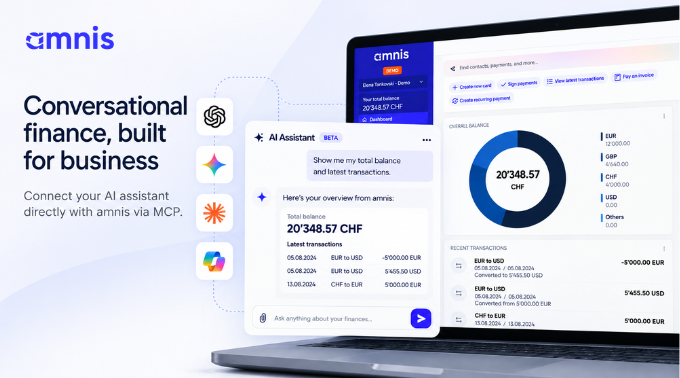
So we took the other route as well. amnis is now accessible through the Model Context Protocol, or MCP. It is an open standard, originally published by Anthropic, that defines how an AI assistant can securely call an external service. Our public API is exposed as a set of tools that any compliant assistant can discover and use: Claude, ChatGPT, Cursor, Gemini and whatever comes next. It is deliberately not tied to one provider. We do not know which assistant our customers will be using in three years, and we do not need to.
Connecting takes about two minutes. The customer authorises amnis once through a standard OAuth flow, the same mechanism used by Figma or Notion, and the tools appear in their assistant, scoped to their own account. No credentials are copied anywhere. Access can be revoked at any time.
What this looks like in practice
A finance lead types a question and gets an answer from live data instead of a file:
“What is our EUR position across all accounts right now?” Answered from live balances, not yesterday’s export.
“Categorise last month’s card transactions and show me where spend is drifting.”
“Prepare the payment for invoice 452 to our supplier in Germany.” Drafted, ready for a person to approve.
“If EUR/USD goes above 1.08, flag it to me.” The assistant checks the rate and tells you, instead of you checking a screen.
Cost patterns nobody was looking for: one customer’s assistant spotted an employee expensing individual train tickets every week, and pointed out that an annual pass would cost around 30% less.
None of that is a mock-up. Here is the amnis MCP server running live:
One of our first beta testers made the point better than any roadmap could. He connected on a Tuesday afternoon, and by the evening he had emailed to say he had built a router agent on top of our MCP server to query several company accounts at once, something our own setup did not support yet. A few hours in, and he was already building beyond what we had shipped. That is the signal we were looking for.
A person still approves. Always.
This is the part I care most about, because it is where trust is either earned or lost. AI suggests. A human decides. Every transaction initiated through an assistant still has to be released by an authorised person with two-factor authentication, exactly as it would be in the app. Nothing moves because a model thought it should.
Role-based permissions and existing signature rules apply unchanged. The assistant inherits them, it does not bypass them.
Every action is logged and auditable, so you can see afterwards what was asked and what was done.
Customer data is not used to train any model, and is covered by the corresponding agreements with our providers.
As a supervised payment institution, security is not a feature for us. It is a licence condition.
There are real risks in this shift and I would rather name them than pretend otherwise. Shadow AI, meaning teams automating processes individually, quickly and without oversight, is easy to start and hard to make safe at scale. Prompt injection is a genuine new attack surface. We take both seriously, which is precisely why we think the sensible answer is a supervised, permissioned, auditable route into finance data rather than leaving people to build their own workarounds.
Why a company our size could move first
Larger institutions are not standing still, but they are carrying a lot of history. One large Swiss institution reportedly ran around 1,200 different tools in parallel at one point. Laying a single, coherent AI layer across a landscape like that is close to impossible.
amnis built its core system and its customer-facing interfaces in-house from the start. That was an expensive decision at the time and it is paying off now: we can ship a change centrally and have every customer on it the same week. It is closer to how a software company operates than to how financial services traditionally have.
What comes next
The MCP server is live and in beta with a first group of customers. We are collecting feedback from them before opening it more widely, because the interesting question is no longer whether the tools work. It is which ones people actually reach for. Alongside it, conversational finance inside the amnis app is in beta for customers with admin access, and we are building agents for specific finance workflows, starting with liquidity management.
None of this replaces judgement. What it removes is the part of finance work that was never judgement in the first place: the exports, the tab-switching, the report you build to find one number. Our people are becoming AI-assisted managers, and the work is moving away from repetitive tasks towards strategy, controlling and steering. I expect the same to happen in our customers’ finance teams.
If your team already works in an AI assistant and you want to try this with your own data, you can register for the MCP beta programme. We are keeping the group small on purpose. We would rather learn properly from a handful of teams than launch loudly to everyone.
As CEO and Co-Founder of amnis, Michael is driven by a clear vision: to simplify international finance for small and medium-sized companies and give them the same global financial capabilities traditionally reserved for large corporations.
With a strong background in finance and treasury management, he regularly publishes expert insights on foreign exchange, international payments and expense management. Michael’s articles help businesses navigate currency volatility, optimise their cross-border payments, and automate their financial operations.
The amnis Subscription Card is a virtual debit Mastercard for AI subscriptions: up to 1% back on qualifying AI tools, no FX markup on USD. Start for free.
From slow, error-prone manual accounting to finance automation: Discover how financial process automation improves tracking, processing, analysis & more.
Travel expense management helps travel agencies simplify billing and reduce costs. Discover the top 5 travel expense management solutions for your agency.
Stay updated
Get the newest insights, expert tips, and research findings delivered straight to your inbox, so you never miss a beat in the industry.