The best way to use PayPal for business
Discover the key advantages of a PayPal business account – and avoid costly forced currency conversions with amnis' multi-currency acquiring solution.


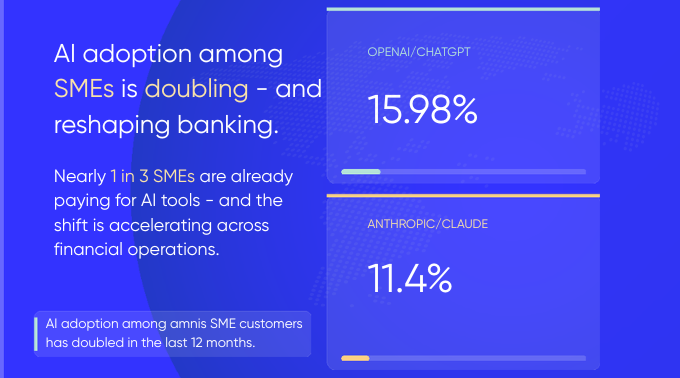
Most forecasts about SME spending are based on surveys. Ours are based on what businesses actually do. Looking across our platform, some clear trends have emerged, and they paint a striking picture: AI adoption among our SME customers has doubled in the last 12 months.
As of March 2026, nearly 1 in 3 amnis SME customers is actively paying for a leading AI platform:
These aren’t vanity metrics or survey responses — these are real transactions processed through amnis. SMEs are putting real money into AI, and the pace is accelerating.
A year ago, these numbers were half what they are today. That kind of growth doesn’t happen by accident. It happens when a technology crosses from “interesting experiment” to “operational necessity.”
The SMEs investing in AI aren’t doing it to impress anyone. They’re doing it because it works — because it helps them do more with the teams they have, move faster than their competitors, and focus human attention where it actually matters.
But here’s the gap: most business banking infrastructure wasn’t built for this. It was built for a world where financial operations were inherently manual — import a file, check a field, approve a payment. That world is ending.
That gap is closing. And we think it closes from the banking side, not just the AI side.
We’re not observing this shift from the sidelines. We’ve been building for it.
Two AI-powered features are already live on the amnis platform today:
These aren’t bolt-on features. They’re the first expression of a larger architectural shift: a platform where AI handles the operational layer so finance teams can focus on the strategic one.
amnis AI Roadmap
Automated categorisation, review, and processing of expenses — no manual input required.
Extract payment data from invoices and documents. Upload, confirm, done.
Query balances, transactions, and accounts in plain language — no dashboards needed.
Surface patterns, anomalies, and financial insights automatically from your data.
Monitors liquidity, flags risks, and executes treasury actions within set parameters.
End-to-end expense management running in the background — from receipt to reconciliation.
Identifies redundant or underused subscriptions and executes consolidations.
Autonomous transactional accounting — classifies, books, and reconciles entries without manual input.
The roadmap ahead is where it gets interesting. Here are some areas we’re exploring as we think about what a truly agentic experience for treasury and finance teams could look like.
Each of these is designed around the same principle: your finance team’s time is valuable. The routine work should be automated. The judgment calls should stay with humans.
The data makes one thing clear: your teams are already working in AI tools. The question isn’t whether AI will be part of your workflow, it’s whether your banking platform can keep up with it.
We think it should. Finance shouldn’t stop at the edge of your banking dashboard. It should be accessible wherever your team actually works. That’s why we’re building an MCP (Model Context Protocol) server for amnis — an open standard that lets AI assistants like Claude and ChatGPT connect directly to external systems. In practice, it means your AI tools will be able to query your amnis account, pull live balances, initiate payments, and surface FX positions — without switching context, exporting files, or copying data across platforms.
Ask your AI assistant “what’s our EUR cash position across all accounts?” and get a live answer, straight from your banking data.
We’re aware that “AI in banking” sounds abstract to some and alarming to others. Our philosophy is clear: AI at amnis is designed to act within boundaries that humans define and approve. Every automated action has a human in the loop — whether that’s setting the parameters, reviewing the output, or approving the transaction.
The SMEs adopting AI fastest are also the ones thinking hardest about where human judgment is irreplaceable. We’re building for them.