


PayPal Currency Conversion Fees – how to save money!
PayPal offers convenient international transactions with fees of up to 5% + PayPal currency conversion fees. Discover what amnis offers as an additional option!


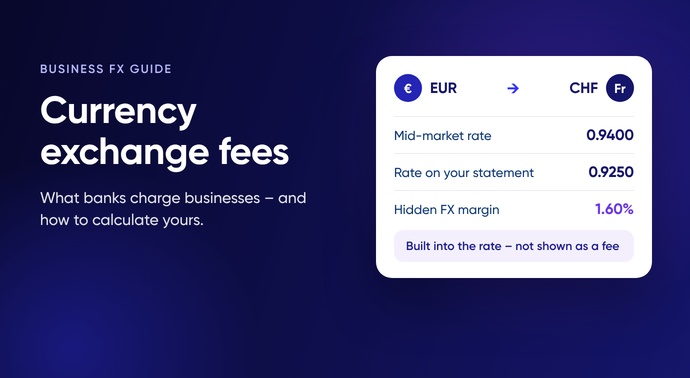
Banks typically charge businesses currency exchange fees of 1% to 2.5% above the mid-market rate, built into the exchange rate rather than shown as a separate fee. Swiss banks charge 1.00% to 2.15%, or 1.60% on average, for exchanges of up to CHF 50,000. Specialised FX providers usually charge 0.2% to 1%.
Swiss banks charge businesses between 1.00% and 2.15% above the mid-market rate, 1.60% on average, according to the amnis comparison of Swiss banks from April 2026. International research points the same way.
A Bank of Canada study from October 2026 looked at what banks quote firms for cross-border payments. Banks charged a total margin of about 2% to 3.5% of the transaction value and were 1.3 to 2.1 percentage points more expensive than payment companies. The authors note that the quotes mostly reflect the costs small and medium-sized companies face.
| Provider type | Typical FX margin above mid-market rate | Notes |
|---|---|---|
| Swiss banks | 1.00% to 2.15% (1.60% average) | Exchanges up to CHF 50,000, amnis comparison April 2026 |
| Standard account transfer at a bank | Up to 2.5% | When currency is converted automatically |
| Airwallex | +0.5% (major currencies), +1% (others) | Published price list |
| Wise Business | From 0.33%, varies by currency | Published price list |
| Revolut Business | Interbank rate within plan allowance, fees above | Depends on plan |
| amnis | From 0.20% (0.20–0.40% by plan), no weekend FX surcharge | 0.6% / 0.45% below CHF 10,000 on Launch / Essential |
Provider information as of November 2026. Bank margins vary by bank, amount, and currency pair.
A foreign currency payment can carry up to four kinds of currency exchange fees and charges, and usually only the transfer fee shows up on your statement. The Bank of Canada study found that the FX margin makes up more than 75% of the total cost.
| Cost | What it is | Where you see it |
|---|---|---|
| FX margin | The difference between the rate your bank gives you and the mid-market rate | Hidden in the exchange rate |
| Transfer fee | A fixed fee per international (SWIFT) payment | Account statement or price list |
| Correspondent fees | Fees taken by intermediary banks along the way, depending on the SWIFT option (SHA, OUR, or BEN) | Your supplier receives less than you sent |
| Timing costs | Worse rates outside market hours, or a rate set when the payment is processed rather than when you approve it | Rarely shown |
The FX margin is the big one. On a EUR 20,000 supplier payment, a fixed transfer fee is a small part of the cost. A 1.60% margin on the same payment costs EUR 320.
How to spot it: compare the rate on your statement with the mid-market rate at the time of the payment. The gap, divided by the mid-market rate, is your margin in percent. In the EU, providers must show conversion charges for card payments as a percentage mark-up over the ECB reference rate, and show estimated conversion charges before you send an online transfer (Regulation (EU) 2019/518).
Multiply your annual foreign currency volume by your bank’s FX margin, then add the transfer fees. Annual FX cost = annual FX volume × FX margin + transfers per year × fee per transfer.
Illustrative calculation – annual FX cost at the Swiss bank range and average vs. amnis:
| Monthly FX volume | Bank at 1.00% | Bank at 1.60% (average) | Bank at 2.15% | amnis, all charges per year |
|---|---|---|---|---|
| CHF 50,000 | CHF 6,000 | CHF 9,600 | CHF 12,900 | CHF 2,390 (Essential: CHF 1,800 FX fee at 0.30% + CHF 590 yearly plan) |
| CHF 200,000 | CHF 24,000 | CHF 38,400 | CHF 51,600 | CHF 6,790 (Professional: CHF 4,800 FX fee at 0.20% + CHF 1,990 yearly plan) |
Illustrative calculation, not an offer. Bank figures: amnis comparison of Swiss banks, April 2026. amnis figures: FX fee plus yearly plan fee under the current price list, for exchanges of CHF 10,000 or more. Transfer fees are not included for either side. Actual costs depend on your bank, amounts, and currency pairs.
The biggest lever is the FX margin: avoid automatic conversions at the bank’s standard rate, which can cost up to 2.5%, and exchange at a fixed, published margin instead.
Card payments abroad carry their own fees. Our guide to hidden foreign transaction fees covers them.
Swiss banks charge businesses 1.00% to 2.15% above the mid-market rate, 1.60% on average, according to the amnis comparison of April 2026. Research by the Bank of Canada found total costs of about 2% to 3.5% of the payment value at banks.
Currency exchange fees are one of the largest hidden costs in international business. At an average of 1.60% at Swiss banks, they quickly add up to thousands or tens of thousands a year. Finding your real margin takes an afternoon, and a provider with a fixed, published margin makes the cost easy to see and to plan.
Check in two minutes whether amnis fits your business, then compare our FX rates with what you pay today.